

A resident calls into a city council meeting to comment on a zoning proposal. A witness testifies from another state. A council member joins a budget hearing from a hospital room. Each of these has become routine, and each depends entirely on AV infrastructure that was designed to support it. Remote participation in government and courtroom meetings is no longer a temporary accommodation. It is a standing operational requirement, with legal obligations attached to how well it works.
Legal and ADA Requirements for Hybrid Government Meetings
Government meetings and court proceedings carry requirements that corporate meetings do not. Open meetings and sunshine laws obligate public bodies to make proceedings accessible to citizens. ADA requirements mandate assistive listening in assembly areas with sound reinforcement. Court proceedings require an accurate record, which means every participant, including a remote witness, must be captured for the court reporter.
When any of this fails, the consequence is not an awkward meeting. It is a potentially challenged proceeding, an accessibility complaint, or a public record with gaps in it. That is why hybrid government meeting AV systems have to be engineered rather than assembled.
Delegate Microphone Systems for Council Chamber AV Integration
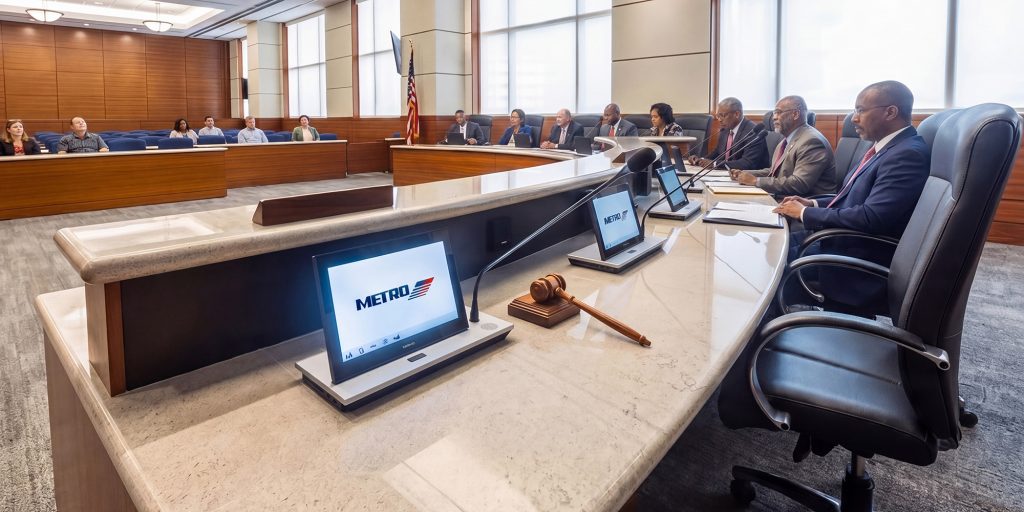
The microphone system is the foundation of any council chamber AV integration. Delegate systems give each council member, commissioner, or board member a dedicated microphone, typically with request-to-speak functionality, chairperson priority control, and an active-speaker limit that keeps the room intelligible.
That structure matters for hybrid participation specifically. Remote attendees cannot rely on visual cues to follow who is speaking, so a system that activates one microphone at a time and routes a clean, gated mix to the far end produces a better remote experience than open microphones competing with one another. Delegate systems also integrate with voting, speaker timers, and agenda management in chambers that need them.
For public comment, a podium microphone for in-person speakers and a managed audio path for remote commenters should feed the same mix, so everyone participating in public comment is heard equally in the room, on the stream, and in the record.
Courtroom AV Technology for Remote Testimony and Virtual Hearings
Courtroom AV technology for remote testimony has a stricter requirement than a typical hybrid meeting: every party must hear every other party clearly, and the court reporter must capture all of it.
How Remote Testimony Works in a Courtroom AV System
Audio from the judge, witness stand, counsel tables, clerk, and podium all routes to the remote participant through a secure video conferencing connection, while the remote participant’s audio feeds the courtroom’s distributed speakers and the assistive listening system. Evidence presentation displays, annotation monitors, and the judge’s control position all have to work for remote parties as well as those present.
Courtrooms are acoustically difficult, with hard surfaces, variable speaker distances, and participants who turn away from microphones. Echo cancellation, gain sharing, and careful gain structure are what prevent a remote witness from becoming unintelligible.
Security Requirements for Remote Hearing Technology
Court proceedings often involve sealed matters, protected witnesses, or juvenile cases. Remote hearing technology for courts and government needs encrypted connections, controlled access, and network architecture that satisfies the court’s IT and security policies. Those requirements should be resolved with court IT staff during design, not discovered during commissioning.
ADA Compliance: Assistive Listening Systems for Courtrooms and Council Chambers
ADA Section 219 requires assistive listening systems in assembly areas that have a public address or sound reinforcement system. Council chambers and courtrooms fall within that requirement, and the obligation includes a specified number of receivers based on seating capacity, a portion of which must be hearing-aid compatible.
Hearing Loop vs. Infrared vs. FM Assistive Listening
Three technologies dominate, and each fits a different situation. Hearing loop (induction loop) systems transmit directly to telecoil-equipped hearing aids and cochlear implants, requiring no receiver to be checked out, which makes them the most dignified option for users and the most maintenance-free for staff. Infrared systems keep audio within the room because IR light does not pass through walls, which matters for courtrooms handling confidential proceedings. FM systems offer the widest range and flexibility, and work well in larger chambers or venues where coverage extends beyond a single room.
The important design point is that assistive listening cannot be treated as an accessory. It has to receive the same complete mix as everyone else, so that a resident using a hearing loop hears remote testimony as clearly as in-room speech.

Government and Courtroom AV Integration from Ford AV
Ford AV designs and integrates AV systems for civic and judicial facilities nationwide. Our government team understands the compliance, security, and operational requirements specific to public sector work.
We engage during design, so microphone placement, camera positions, assistive listening coverage, acoustic treatment, and network requirements are resolved before construction. We coordinate with IT and security staff on network segmentation and access controls, and we back installations with managed services and remote monitoring.
Government Meetings Frequently Asked Questions
What AV technology is needed to support remote participation in government meetings?
Supporting remote participation in government and civic meetings requires delegate microphone systems for in-room speakers, video conferencing integration for remote participants, broadcast-quality streaming for public viewing, recording and archiving systems for meeting records, and ADA-compliant assistive listening technology. A centralized control system ties these components together so clerks and AV staff can manage the full meeting workflow from a single interface.
How do AV systems support remote testimony in courtrooms?
Courtroom AV systems support remote testimony by routing audio from all in-room microphones, including judge, attorneys, witness, and clerk positions, to a far-end participant via secure video conferencing, while simultaneously feeding the remote participant’s audio through the distributed speaker system and assistive listening devices. All parties, including the court reporter, receive a consistent, clear audio record of the full proceeding.
What ADA requirements apply to government meeting rooms and courtrooms?
ADA Section 219 requires assistive listening systems in any assembly area with a public address or sound reinforcement system, including council chambers and courtrooms. Compliant systems typically include hearing loop (induction loop), infrared (IR), or FM-based receivers compatible with hearing aids and cochlear implants. Ford AV designs and integrates ADA-compliant assistive listening alongside the broader AV system to ensure all requirements are met at installation.
How does Ford AV support government and courtroom AV projects?
Ford AV has designed and integrated AV systems for some of the most prominent civic facilities in the country, including the U.S. Capitol Building, the Colorado Capitol Building, and Reagan National Airport. Ford AV’s government AV team brings deep familiarity with the compliance, security, and operational requirements of public sector facilities, from council chambers and legislative spaces to judicial courtrooms and emergency operations centers.
Partner with Ford AV for Government and Courtroom Remote Participation AV Integration
- Civic and Judicial AV Expertise – Ford AV designs and integrates AV systems for municipalities, county governments, state agencies, and judicial courts nationwide, from council chambers to courtrooms and emergency operations centers.
- Proven Government Project History – Ford AV’s civic portfolio includes the U.S. Capitol Building, the Colorado Capitol Building, and Reagan National Airport.
- ADA and Compliance-Driven Design – Assistive listening, accessibility, records retention, and open meetings requirements are addressed during design rather than corrected after inspection.
- Secure Hybrid Meeting and Remote Testimony Infrastructure – Encrypted conferencing, network segmentation, and access controls designed in coordination with your IT and security teams.
- Operable by Your Staff – Control interfaces built for clerks, bailiffs, and court personnel, standardized across rooms and facilities to reduce training and support burden.
- Managed Services and Remote Monitoring – Proactive monitoring, preventive maintenance, and rapid response keep chambers and courtrooms ready for every scheduled proceeding.
Ready to Upgrade Your Chamber or Courtroom for Hybrid Participation?