
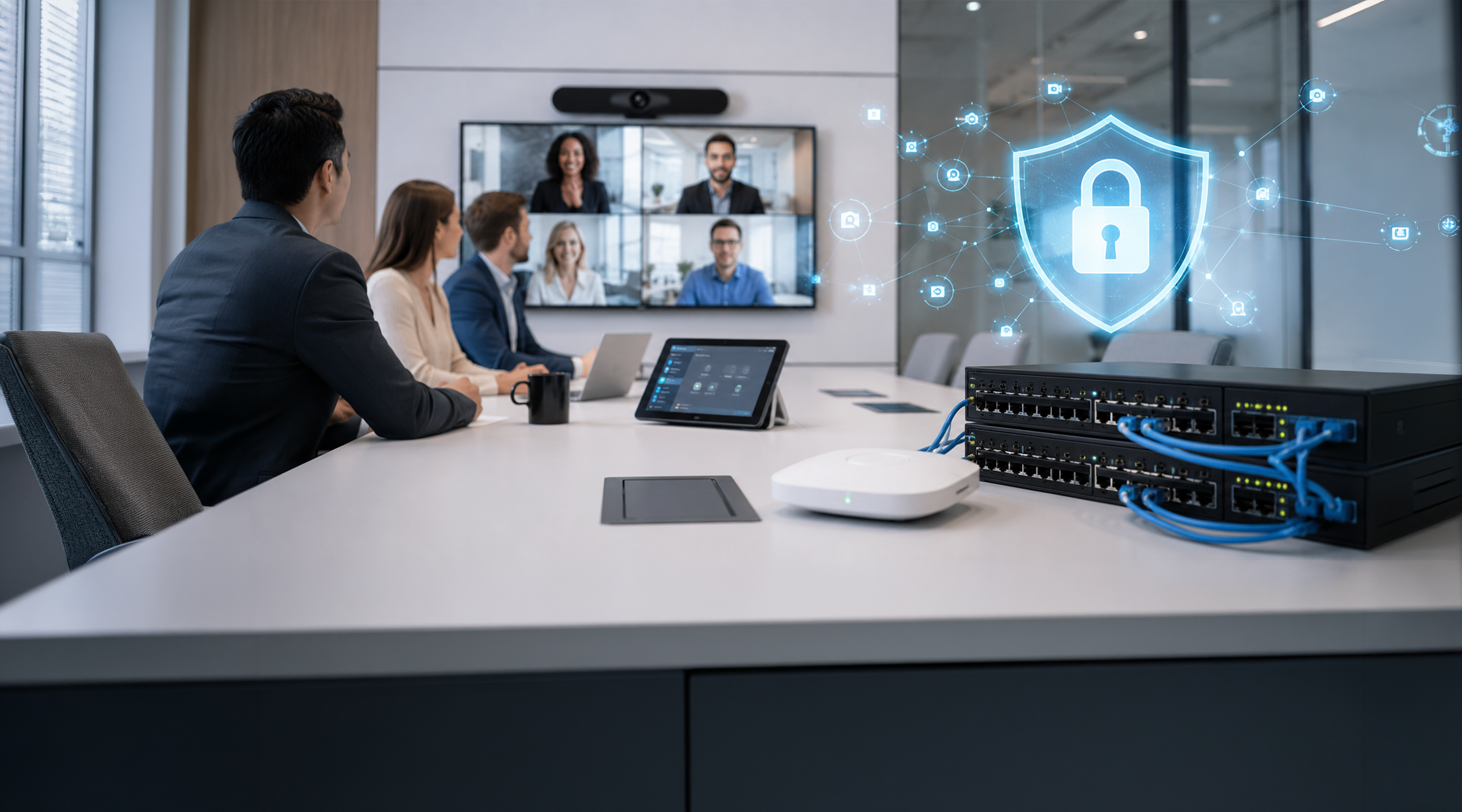
A contractor arrives to service a conference room display, finds an open Ethernet port under the table, and plugs in a laptop. On a flat network, that laptop can now see control processors, DSPs, cameras, signage players, and whatever else shares the segment. Nobody did anything malicious. The room simply had no boundary around it. That gap is what AV network security exists to close.
Conference room cameras, digital signage, control processors, audio DSPs, wireless presentation systems, video conferencing endpoints, and networked displays do not look like computers. From a cybersecurity standpoint, they increasingly need to be treated like them. As AV systems have moved onto the network, the line between AV and IT has largely disappeared. Modern AV devices have IP addresses, web interfaces, firmware, open ports, and remote management capabilities. That connectivity makes AV systems more powerful and far easier to manage, and it also creates another potential path into an organization’s technology infrastructure.
The question is no longer only whether the IT network is secure. Technology leaders also need to know whether their AV network security posture holds up.
Why AV Network Security Deserves More Attention
Organizations have spent decades strengthening traditional IT security. Firewalls, endpoint protection, multifactor authentication, access controls, and continuous monitoring are now standard components of enterprise cybersecurity programs. AV has rarely received the same scrutiny.
AV systems used to be isolated, analog, or treated as specialized building technology that lived outside the IT department’s scope. That is no longer how these systems work. Video conferencing platforms, AV-over-IP distribution, digital signage networks, cameras, and control systems routinely communicate across enterprise networks, and many of them connect to cloud services for management, content, or licensing.
The result is an expanding attack surface. A compromised AV device is rarely the objective itself. It is a starting position, a foothold from which an attacker attempts to move toward something more valuable.

Five Steps Toward Stronger AV Network Security
Improving AV network security does not require rebuilding an organization’s technology infrastructure. A handful of fundamental practices meaningfully improve the security posture of most AV environments.
1. Segment AV From Other Network Traffic
Network segmentation contains incidents by limiting where devices are permitted to communicate. AV, corporate IT, guest access, and building systems can each be separated according to their actual requirements. Creating VLANs is the starting point, not the finish line. Organizations should also apply access controls, traffic inspection, and policies that define which devices can talk to which systems, through which ports, and under what conditions. The goal is not separation for its own sake. It is controlled communication.
2. Know What Is Connected
You cannot protect devices you do not know exist. Technology teams need visibility into AV assets across the enterprise: what is deployed, where it sits, how it connects, what firmware it runs, and who is accountable for it. That visibility becomes harder and more valuable as an organization scale. An enterprise with hundreds of conference rooms, classrooms, and public displays across multiple buildings will not maintain an accurate AV inventory by memory or spreadsheet. Remote monitoring platforms exist in part to solve this problem.
3. Control Network Access
An unused Ethernet jack should not function as an open invitation. Port authentication technologies such as 802.1X require devices to authenticate before they receive network access, and unused ports can be administratively disabled to reduce unnecessary exposure. Physical access to public-facing displays, exposed USB ports, and accessible network connections are all part of the security picture, not just the equipment behind the locked rack room door.
4. Keep AV Firmware Current —Intentionally
Firmware updates often address security vulnerabilities, but blindly applying them can create compatibility or performance issues in interconnected AV systems. The answer isn’t to avoid updates—it’s to manage them intentionally. Organizations should have a defined process for monitoring, evaluating, testing, and scheduling firmware updates. The goal is to close known security vulnerabilities without introducing new problems, keeping AV systems secure, stable, and supported.
5. Have a Plan Before Something Happens
If a networked display, conferencing system, or control processor is suspected of being compromised, what happens next? Can the device be isolated without taking down an entire building’s AV environment? Who gets called first: IT, cybersecurity, facilities, the AV team, or the integrator? Those decisions are far easier to make in advance. AV belongs in the organization’s broader cybersecurity and incident response planning, with defined isolation procedures and clear ownership.
AV Network Security Requires AV and IT to Work Together
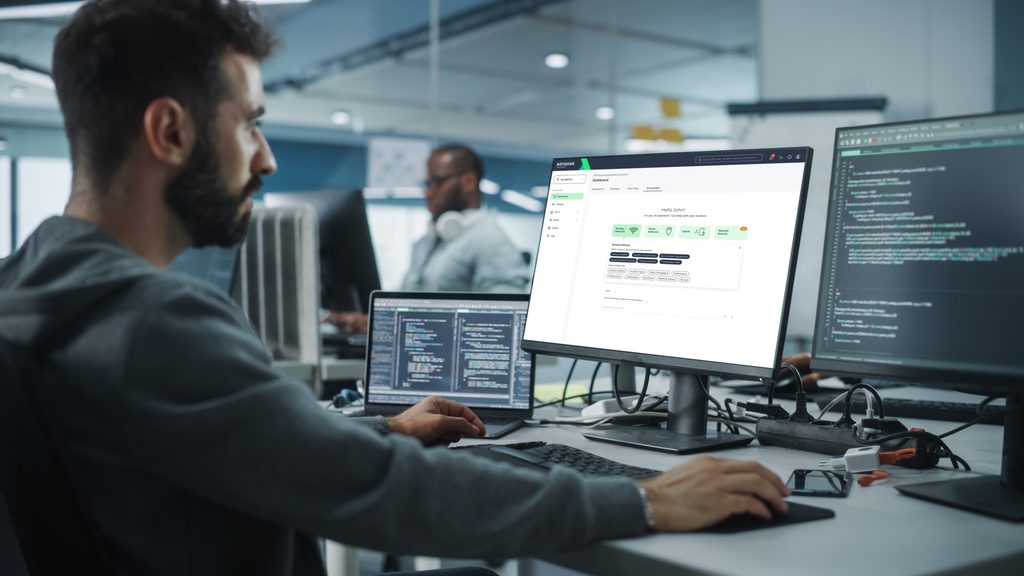
The most effective approach is not AV versus IT. It is AV with IT. AV professionals understand the specific requirements of multicast traffic, AV-over-IP, Dante, conferencing platforms, and control systems, including the ways generic network policy can break them. IT and cybersecurity professionals bring expertise in network architecture, identity, access management, monitoring, and enterprise policy. Systems that are both secure and functional require both perspectives, and the projects that struggle are almost always the ones where these teams met for the first time during commissioning.
AI Raises the Stakes
Artificial intelligence has changed the economics of the attack. Adversaries now have tools that automate discovery, identify vulnerabilities, and operate on a scale that previously required significant human effort.
That makes basic security hygiene more important, not less. Organizations should not assume they are too small, too obscure, or too disconnected to draw attention. Automated attacks do not select targets based on who an organization is. They find devices because those devices are reachable. For AV teams, that means overlooked equipment carries more weight in the organization’s overall security posture than it used to.
AV Network Security Should Begin With the Design
Cybersecurity should not be bolted onto an AV system after installation. Network architecture, device access, segmentation, remote management, firmware strategy, and coordination with the client’s IT organization all belong in the design phase, before equipment is purchased. Bringing the AV integrator, IT team, cybersecurity staff, and designers together early surfaces requirements while they are still inexpensive to address. It also prevents the late-stage conflict where a security policy and an AV design turn out to be incompatible weeks before opening.
Ford AV designs, installs, and supports AV environments that meet an organization’s collaboration and communication needs while fitting responsibly into its broader technology infrastructure. Our engineers work directly with client IT and security teams on network design, segmentation, access control, and remote management. We document what we deliver so that those teams can maintain it. As AV and IT continue to converge, a reliable AV system is not simply one that works. It is one designed with AV network security in mind from the beginning.
Frequently Asked Questions
What is AV network security?
AV network security is the practice of protecting network-connected audiovisual devices, including displays, cameras, control processors, DSPs, and conferencing systems, as part of an organization’s broader cybersecurity program. It covers network segmentation, access control, firmware management, asset visibility, and incident response planning for AV endpoints.
Why do AV systems create cybersecurity risk?
Modern AV devices are network-connected endpoints with IP addresses, firmware, web interfaces, and open ports. A compromised display, camera, or control processor is rarely the attacker’s objective, but it can serve as an entry point for more valuable systems on the network.
How should AV systems be segmented from other network traffic?
During design, not after installation. Network architecture, segmentation, device access, remote management, and firmware strategy should be defined before equipment is purchased, with the integrator, IT team, and security stakeholders aligned from the beginning.
Partner with Ford AV for Secure AV Design and Integration
- AV Designed for the Enterprise Network – Ford AV engineers AV systems as part of your broader technology infrastructure, with segmentation, access control, and remote management addressed during design rather than after installation.
- Coordination Between AV, IT, and Security Teams – Our engineers work directly with client IT and cybersecurity stakeholders to align AV network security requirements with enterprise network architecture and security policy.
- Documented, Supportable Systems – Every system Ford AV delivers includes complete documentation of programming, network configuration, device inventory, and integration points.
- Remote Monitoring and Asset Visibility – Through our AVRMM program, Ford AV provides visibility into AV device health, firmware status, and connectivity across the enterprise, giving technology teams the inventory they need to manage risk.
- Ongoing Firmware and Lifecycle Support – Managed services include scheduled firmware review, preventive maintenance, and rapid-response support that keep AV endpoints current rather than frozen in their installation-day configuration.
Ready to Plan a New AV System or Evaluate an Existing Environment?