
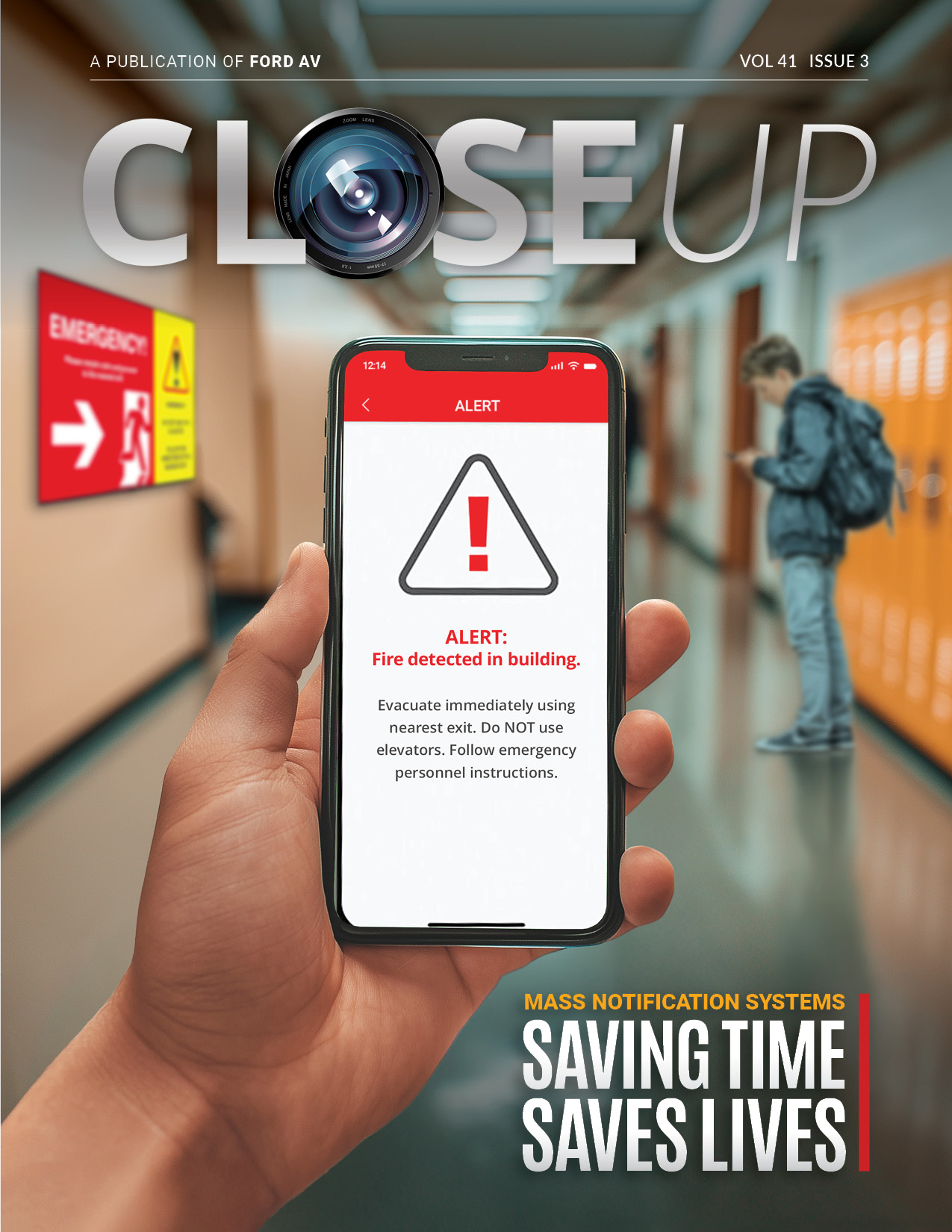
Mass Notification Systems: Saving Times Saves Lives
Mass communication systems enable organizations to deliver critical information quickly and reliably across facilities, campuses, and enterprise environments. Ford AV designs and integrates scalable mass notification and emergency communication systems that support safety, operational continuity, and real-time coordination.
Benefits of Integrated Mass Communication Systems


Deliver Real-Time Emergency Alerts Across Multiple Channels
Audio, visual, SMS, email, desktop notification

Centralize Communication Management
Faster, clearer instructions reduce confusion during incidents

Integrate with Fire Alarms, Surveillance, and Access Control
Automated triggers expand reach and reduce manual steps

Improve Campus
and Facility Safety
Single console for multi-site, multi-channel messaging and reporting

Reduce Response Time During Critical Events
Direct links to first responders and panic alert systems shorten dispatch intervals

Support Daily
Operational Messaging
Announcements, wayfinding, and routine alerts use the same infrastructure
Components of a Mass Communication System
Public Address & Paging Systems
Enterprise-grade audio systems for campus-wide voice announcements and emergency instructions.
- Tuned speakers ensure clear speech in noisy or large spaces.
- Emergency messages override routine audio automatically.
- Zoned paging targets specific buildings, floors, or rooms.
- Redundant audio paths maintain announcements during failures.
Digital Signage & Visual Alerts
Integrated displays that provide visual emergency messaging and real-time updates.
- On-screen alerts display clear text and graphics instantly.
- Displays show location-specific evacuation routes and maps.
- Emergency templates replace normal content automatically.
- Scheduled templates let signage serve daily and emergency use.
Mass Notification Software Platforms
Centralized platforms enabling multi-channel alerts via audio, visual, SMS, email, and desktop notifications.
- Alerts deliver via audio, SMS, email, desktop, and apps.
- Targeting sends messages by role, location, or device.
- Delivery receipts and logs support compliance reporting.
- Prebuilt workflows and templates speed incident response.
Integration with Security & Fire Systems
Unified integration with surveillance, access control, and fire alarm systems to trigger automated alerts.
- Sensors can trigger preconfigured alert sequences automatically.
- Audio, visual, and access control actions synchronize.
- Escalation rules adjust alerts by sensor, location, and time.
- Unified dashboards show sensor status and notification progress.
Networked Audio & Distributed Systems
IP-based audio systems supporting multi-building and multi-site deployments.
- IP audio supports centralized control with local survivability.
- Use of PoE and VLANs reduces cabling and installation cost.
- Remote monitoring enables centralized endpoint management.
- Dynamic zoning and failover keep audio paths available.
Mass Communication Systems for Every Industry
Integrated Communication & AV Ecosystems
Integration with existing AV infrastructure – leverage collaboration rooms, VoIP phones, and digital signage as endpoints.
Unified control systems – single-pane management for alerts, presets, and escalation paths.
Network security alignment – architecture options for on-premises, cloud, or hybrid deployments that meet IT policies.
Centralized management – remote monitoring, software updates, and reporting across all sites
Alyssa’s Law
Alyssa’s Law was named in honor of Alyssa Alhadeff, a 14-year-old victim of the Marjory Stoneman Douglas High School tragedy. This legislation mandates that public school buildings be equipped with silent panic alert systems that are directly linked to law enforcement and first responders.
The law aims to reduce response times during life-threatening events by enabling immediate notification to authorities—without the need to make a call. Integrated into a well-designed Emergency Communication System, panic alert technology can:
- Trigger mass communication protocols instantly
- Alert law enforcement while simultaneously broadcasting lockdown or evacuation instructions
- Coordinate visual, audio, and digital alerts for faster decision-making
As more states adopt Alyssa’s Law, schools must ensure their communication infrastructure is up to the challenge. Ford AV’s MNS solutions not only support compliance but also exceed expectations for safety, reliability, and speed.
Featured Mass Communication System Integration

Circuit of the Americas
Ford AV upgraded venue-wide mass communication to support race-day operations, guest messaging, and emergency notification across the three-mile facility. Ford AV delivered a large-scale audio and notification solution that meets NFPA‑72 standards and supports both live and pre-recorded announcements
Managed Services for Mass Communication Systems
Just like other emergency devices and safety equipment, mass communication systems require maintenance.

Preventative Maintenance
Regular inspections and component replacement

System Testing & Compliance Checks
Scheduled drills and reporting for audits

Remote Monitoring
& Diagnostics
Proactive fault detection and remote fixes

Software Updates & Firmware Management
Keep platforms current, secure, and running smoothly

Multi-Site
Enterprise Support
Updates and configuration management across locations

24/7 Service
Availability
Optional around-the-clock support for mission-critical systems
Mass COmmunication Systems (FAQ)
How does a mass communication system differ from a standard fire alarm?
A mass communication system delivers coordinated audio, visual, and digital messages across multiple channels and can be triggered by fire alarms, but it also supports targeted messaging, analytics, and multi-channel redundancy.
What deployment models are available?
On-premises, cloud, and hybrid models are available to align with IT policies, latency needs, and redundancy requirements.
Can we use existing speakers and displays for mass notification?
Yes. IP-enabled speakers, VoIP phones, and digital signage can be integrated as endpoints to extend reach and reduce cost.
Why Choose Ford AV
Ford AV designs and integrates mass communication systems for organizations across the United States, with regional offices providing local support and nationwide project delivery.
Partner with America’s Leading AV Technology Company

50+ Years of Experience – Designing and integrating enterprise mass notification and emergency communication systems for schools, healthcare, and government facilities.
Nationwide Deployment and Support – Local teams backed by a national network for reliable system installation, commissioning, and ongoing service.
Comprehensive Mass Notification Solutions — From IP-based paging and digital signage to multi-channel notification platforms and security-system integration.
Scalable, Future-Ready Integration – Engineered for multi-site deployments, redundancy, and evolving IT and security requirements.
Proven Video Performance – Trusted by educational institutions, healthcare organizations, government agencies, corporate campuses, and houses of worship.
Ready to prepare your facility with secure mass notification systems? Fill out the form below to connect with Ford AV professionals.
Resources
Mass Notification Systems

Nationwide Mass Communication System Deployment
Ford AV designs and integrates mass communication systems for organizations across the United States, with regional offices providing local support and nationwide project delivery.